Office Door Signs Selection Guide for Workplace Procurement
Office door signs selection guide: acrylic, metal, glass, and ADA tactile signs by cost, durability, and corporate identity for workplace procurement.
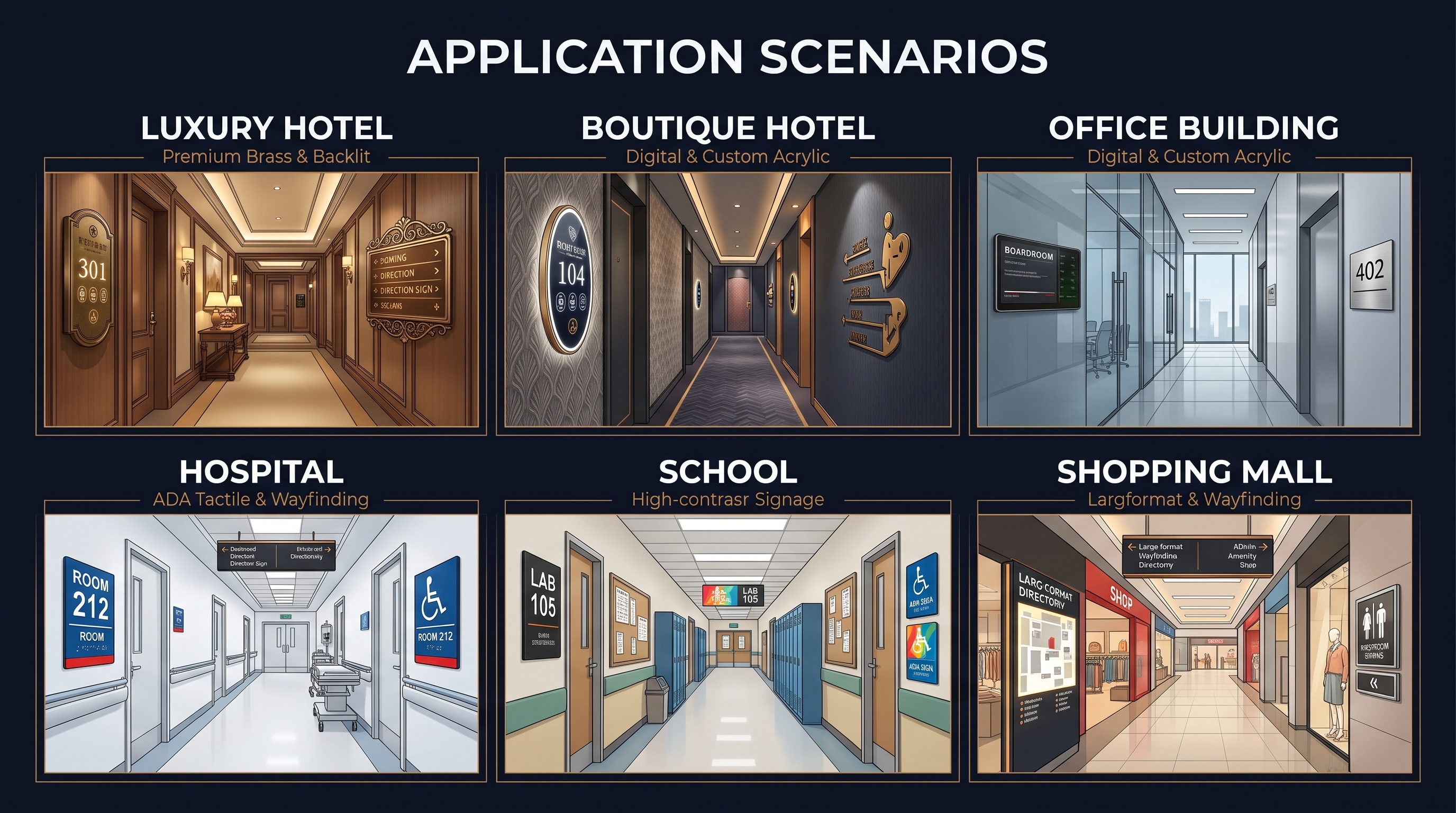
Office door signs are a high-leverage specification for workplace managers, facility directors, and corporate real estate procurement teams. A complete office door signs selection guide addresses the four essential decision points a procurement team must resolve: which physical format matches the corporate identity, which mounting method fits the wall or glass partition construction, which visibility technology serves the office environment, and how the office door sign integrates with wayfinding and meeting room booking systems. The office door signs category has expanded dramatically in the last decade with the rise of activity-based working, hot-desking, and hybrid office models, where room status and occupant information must be communicated visually in real time. For procurement teams, the right office door signs selection balances material cost, durability under daily staff interaction, ADA compliance where applicable, and integration with the digital workplace tools that office workers and visitors depend on throughout every workday.
Office door signs are permanent architectural elements that anchor the visual identity of a workplace while serving critical wayfinding, room identification, and privacy communication functions. Unlike temporary hotel door signs, office door signs are installed once and remain in place for seven to fifteen years, with very low replacement frequency under normal office operating conditions. The office door signs category also varies significantly in cost per piece, ranging from under five dollars for printed acrylic to several hundred dollars for backlit glass with digital integration. This office door signs selection guide walks procurement teams through the trade-offs across cost, durability, visibility, and operational integration to arrive at the right specification for their workplace tier, corporate identity, and operational model.
Why Office Door Signs Selection Drives Workplace Wayfinding and Identity
Office door signs selection drives workplace wayfinding and identity because the office door sign is the primary visual cue that staff and visitors use to locate the right room, identify the right occupant, and understand the room's current status. Without a clear and consistent office door signs system, visitors waste time wandering corridors, staff hold meetings in the wrong room, and the workplace loses the operational efficiency that the office layout was designed to deliver. The office door signs category, when properly specified, eliminates this confusion and creates a coherent spatial language that reinforces the corporate identity at every doorway. The cost of poor office door signs selection is not just visitor frustration but measurable productivity loss when staff spend five to fifteen minutes per meeting locating the right room or contacting a colleague to confirm the room assignment.
Office door signs must be visible from the approach direction of staff and visitors, which means size, contrast, mounting position, and finish selection are all critical specification decisions. The office door sign must align with the corporate brand standard, must be durable enough to survive routine cleaning and incidental contact, must be consistent in typography and color across the workplace so visitors can identify the room type at a glance, and must integrate with the wayfinding system so the same visual language communicates room function, occupant, and current status. Office door signs also serve as a corporate identity touchpoint: a well-designed office door sign communicates the brand values of the company at the moment a visitor enters a room, reinforcing the corporate identity in a way that no internal signage channel can match.
The strategic dimension of office door signs selection extends to the broader workplace technology stack. Modern workplaces increasingly integrate digital meeting room booking systems such as Robin, Envoy, Teem, or Condeco, where the office door sign displays real-time room availability and meeting details through an integrated screen. The office door signs selection guide treats this integration as a primary specification axis, because the right digital integration can eliminate the meeting room conflicts that consume five to fifteen percent of meeting time in workplaces with substandard room booking. Properties that invest in digital office door signs typically recover the integration cost within 12 to 24 months through reduced meeting friction and improved workspace utilization.
Office door signs also carry an ADA compliance dimension that procurement teams must address. The Americans with Disabilities Act and equivalent international standards require tactile room identification at specific heights and with specific character heights for permanent rooms in most commercial facilities. The office door signs selection guide treats ADA tactile signage as a baseline specification rather than an optional add-on, because non-compliant office door signs create legal exposure and exclude staff and visitors with visual impairments from independent navigation. Properties that specify ADA-compliant office door signs from the initial deployment avoid the costly retrofit that properties with substandard specifications face when ADA compliance is enforced through audit or complaint.
Beyond ADA, a modern workplace signage specification must also address cognitive accessibility. A worker recovering from a concussion, a visitor with mild cognitive impairment, or a new hire unfamiliar with the floor plan all benefit from signage that uses plain language, clear iconography, and consistent room naming conventions. The most effective workplace signage systems pair the tactile and visual identification with a color-coded room type indicator, such as blue for focus rooms, green for collaboration rooms, and orange for phone booths, so that the room function can be understood at a glance without reading the full room name. This color-coded layer is not mandated by ADA but it measurably improves independent navigation for staff and visitors with cognitive load, and it reduces the front desk interruption rate in workplaces with high visitor traffic.
The corporate identity dimension of workplace signage also extends to the typography and naming convention choices. A workplace that uses inconsistent room naming, such as mixing Room 101, Boardroom A, and The Hub on the same floor, fragments its spatial language and increases visitor confusion. The most effective workplace signage specifications adopt a consistent naming convention, such as a floor prefix plus a sequential number plus a room type suffix, applied uniformly across the entire portfolio. This consistency allows staff and visitors to predict room location and function from the name alone, which reduces wayfinding time and reinforces the corporate identity through disciplined visual language.
Acrylic Office Door Signs — Modern Style, Cost-Efficient Customization
Acrylic office door signs are the modern style, cost-efficient customization option that has become the baseline specification for most contemporary workplaces. Acrylic office door signs are manufactured from cast or extruded acrylic sheets, typically 3 to 6 millimeters in thickness, with the room name, occupant name, and graphic elements digitally printed or vinyl-applied on the face. The acrylic material is lightweight, easy to cut to custom shapes, and accepts a wide range of finish options including frosted, clear, colored, and back-painted variants. For workplaces with high customization requirements and tight procurement budgets, acrylic office door signs deliver the best balance of cost, customization, and visual quality.
Acrylic office door signs are typically priced between three and fifteen dollars per piece, depending on size, finish, and customization scope. The cost advantage over glass and metal is significant, particularly for workplaces with hundreds of rooms where the unit cost differential compounds into meaningful total project savings. A 200-room office building switching from glass to acrylic office door signs can save $20,000 to $40,000 on the initial specification, which is meaningful even for large corporate real estate budgets. The cost savings can be redirected to higher-leverage workplace investments such as digital meeting room displays, wayfinding kiosks, or visitor management systems.
Acrylic office door signs are also faster to manufacture and replace than glass or metal alternatives. A standard acrylic office door sign can be produced and shipped within five to ten business days, while a custom glass or metal sign may require three to six weeks. This speed advantage is particularly important for fast-growing workplaces, where new rooms or new occupants must be added to the office door signs inventory on weekly or monthly cadences. The office door signs selection guide treats acrylic as the default specification for workplaces with high churn or growth, because the speed of replacement minimizes the operational disruption of new hire additions or departmental moves.
Acrylic office door signs do have a notable limitation: they scratch more easily than glass or metal, and the printed or vinyl-applied surface can degrade over time with routine cleaning. The office door signs selection guide recommends that workplaces specifying acrylic office door signs for high-touch corridors use UV-stable inks and protective overlaminates, and that cleaning protocols use non-abrasive cleaners and soft cloths. With proper care, acrylic office door signs can last seven to ten years in indoor office environments, which is comparable to glass and adequate for most workplace refresh cycles.
Acrylic also has a fire rating consideration that is often overlooked. Untreated acrylic is combustible and does not meet fire code requirements for certain applications, particularly in egress corridors and in facilities with strict fire rating mandates. Fire-rated acrylic or alternative materials must be specified for these locations, and the procurement team must verify that the sign material carries the appropriate fire rating certification from a recognized testing laboratory. The office door signs selection guide recommends a fire code review at the specification phase for facilities in high-rise buildings, healthcare environments, and government facilities where fire code compliance is routinely audited.
The environmental profile of acrylic is another specification dimension. Conventional acrylic is petroleum-based and is not biodegradable, but it is recyclable through specialized programs and several manufacturers now offer recycled-content acrylic that reduces the carbon footprint of each sign. Workplaces with corporate sustainability goals should specify recycled-content acrylic and should request an environmental product declaration from the manufacturer to verify the recycled content percentage and the carbon emissions per unit. The office door signs selection guide treats sustainability as a secondary but legitimate specification axis, and the incremental cost of recycled-content acrylic is typically under ten percent of the unit price, which is negligible for most workplace budgets.
Metal Office Door Signs — Premium Heft and Architectural Integration
Metal office door signs deliver premium heft and architectural integration that justifies the higher unit cost for executive suites, boardrooms, and high-visibility client-facing areas. Metal office door signs are typically manufactured from anodized aluminum, brushed stainless steel, or solid brass, with the room name and graphic elements mechanically engraved, laser etched, or chemical milled into the face. The metal material communicates permanence, quality, and corporate gravitas in a way that acrylic cannot replicate. For workplaces with a premium corporate identity or with high-end client-facing areas, metal office door signs are the default specification.
Metal office door signs are typically priced between fifteen and eighty dollars per piece, depending on material, size, and customization scope. The cost premium over acrylic is significant, and the premium is justified only when the visual impact of the metal sign reinforces a specific corporate objective. A boardroom, an executive suite, a flagship reception area, or a high-profile client meeting room are all strong candidates for metal office door signs, while a general office corridor with multiple mid-level meeting rooms is a poor candidate because the per-room impact is diluted and the total cost compounds quickly. The office door signs selection guide treats metal office door signs as a targeted specification for high-impact areas, not as a default for the entire workplace.
Metal office door signs also offer superior durability compared to acrylic. A metal sign can last fifteen to twenty years in indoor office environments with minimal maintenance, while an acrylic sign typically requires replacement at seven to ten years. The longer service life partially offsets the higher unit cost, particularly for workplaces with infrequent refresh cycles. The office door signs selection guide recommends that workplaces planning to retain their office layout for ten or more years consider metal office door signs for high-impact areas, because the lifecycle cost over the asset life is comparable to acrylic even though the unit cost is higher.
Metal office door signs are also more sustainable than acrylic at end of life. Aluminum and stainless steel can be recycled indefinitely without quality degradation, while acrylic is downcycled into lower-grade products or sent to landfill. Workplaces with corporate sustainability commitments may specify metal office door signs for this reason, particularly in high-impact areas where the sustainability message is visible to visitors and staff. The office door signs selection guide treats sustainability as a secondary but legitimate specification axis, particularly for workplaces with published environmental goals.
Metal office door signs also have a fire rating advantage. Most metal sign materials, particularly aluminum and steel, are non-combustible and meet or exceed fire code requirements for all applications without additional certification. This fire rating advantage simplifies specification for facilities with strict fire code mandates, such as healthcare facilities, government buildings, and high-rise towers, because the procurement team does not need to verify separate fire ratings for different sign locations. The office door signs selection guide recommends that facilities with complex fire code requirements prioritize metal signage to simplify compliance.
The acoustic performance of metal signage is another consideration, particularly for open-plan workplaces and for meeting rooms adjacent to quiet zones. A metal sign installed on a glass partition can reflect sound and contribute to noise propagation in ways that an acrylic or glass sign does not. This acoustic impact is minor for most workplaces but is meaningful for acoustically sensitive environments such as recording studios, research facilities, and executive offices where speech privacy is critical. The office door signs selection guide recommends that acoustically sensitive workplaces specify glass or acoustic-grade acrylic rather than metal for signs installed on glass partitions.
Glass Office Door Signs — Premium Transparency for Modern Workplaces
Glass office door signs deliver premium transparency for modern workplaces with extensive glass partition construction. Glass office door signs are typically manufactured from tempered or laminated glass, with the room name and graphic elements applied through ceramic frit printing, vinyl application, or back-painting. The glass material matches the glass partition aesthetic perfectly, creating a coherent visual language across the entire wall and door surface. For modern workplaces with significant glass partition construction, glass office door signs are the default specification because no other material integrates as seamlessly with the wall system.
Glass office door signs are typically priced between thirty and one hundred and fifty dollars per piece, depending on size, customization, and integration scope. The cost premium over acrylic and metal is significant, but the visual integration with the wall system is unique to glass. Workplaces with extensive glass partition construction typically accept the premium as part of the broader architectural investment, and the cost is often bundled with the partition system rather than the office door signs budget. The office door signs selection guide treats glass office door signs as the default for glass-heavy workplaces, and as a targeted premium specification for boardrooms and executive areas in non-glass workplaces.
Glass office door signs are also compatible with digital integration in a way that other materials are not. A glass office door sign can be combined with a backlit LCD or E-Ink display behind the glass, providing real-time room status and meeting information while maintaining the glass aesthetic. This digital glass office door sign is the premium specification for executive boardrooms and high-traffic meeting rooms, and it commands a price point of two hundred to one thousand dollars per piece depending on screen size and integration scope. The office door signs selection guide treats digital glass office door signs as the highest-leverage specification for boardrooms, because the meeting efficiency benefit typically justifies the cost within 18 to 36 months.
Glass office door signs do have a notable limitation: they are more difficult to update than acrylic or metal. Replacing the graphic on a glass sign requires either replacing the entire sign or applying a new vinyl overlay, both of which require professional installation. For workplaces with high churn or growth, the update cycle for glass office door signs can become a significant operational burden. The office door signs selection guide recommends that workplaces with high churn specify glass office door signs with modular graphic systems that allow in-place updates without full sign replacement, even though the per-unit cost is higher.
Glass office door signs also carry a safety certification dimension. Tempered glass, also known as safety glass, breaks into small granular pieces rather than sharp shards, which is a legal requirement for most interior glass applications. The procurement team must verify that the glass signage carries the appropriate safety certification, such as the ANSI Z97.1 standard or the European EN 12150 standard, and must request a certification document from the manufacturer. The office door signs selection guide treats safety certification as a non-negotiable specification, because non-certified glass signage creates a safety and liability exposure that no cost savings can justify.
Glass office door signs also have a weight consideration, particularly for large signs and for signs installed on lightweight partition systems. A large glass sign can weigh several pounds and may require additional structural support at the mounting point, which increases installation labor and may require coordination with the partition system manufacturer. The office door signs selection guide recommends that the installation labor estimate include a structural support check for any glass sign exceeding a specified weight threshold, and that the procurement team verify the wall or partition capacity before finalizing the glass specification.
ADA-Compliant Office Door Signs — Tactile and Braille Requirements
ADA-compliant office door signs are the tactile and braille requirement that procurement teams must address for permanent rooms in commercial facilities. The ADA Standards for Accessible Design require tactile room identification with raised characters, Grade 2 braille, and a specific character height and contrast for permanent rooms. The office door signs selection guide treats ADA tactile signage as a baseline specification for all permanent rooms, with the only variable being the material, finish, and integration approach. Workplaces that skip ADA compliance in the initial specification face costly retrofit projects and legal exposure when accessibility audits or complaints are filed.
ADA-compliant office door signs are manufactured from any of the four primary materials discussed in this guide, with the tactile requirement typically implemented through raised characters applied to the sign face or through a separate tactile panel. The braille requirement is implemented through Grade 2 braille applied as individual beads or as a single panel. The office door signs selection guide recommends that workplaces specify ADA tactile and braille from a manufacturer with documented ADA compliance experience, because the character height, spacing, and braille dot dimensions are precisely specified in the standard and must be implemented to specification to be compliant.
ADA-compliant office door signs also have a placement requirement. The ADA Standards specify that tactile signs must be installed on the latch side of the door at a specific height range, with a specific offset from the door frame. The office door signs selection guide recommends that the placement specification be coordinated with the architectural plans during the design phase, because retrofitting ADA tactile signs to non-compliant placement is a common cause of accessibility audit failures. Workplaces that integrate ADA placement into the initial architectural drawing avoid the costly relocation of tactile signs during the post-occupancy compliance review.
The international equivalents of ADA tactile signage include the Canadian Standards Association standard, the European EN 17210, and various national standards in Asia and the Middle East. Workplaces with international operations or with global brand standards must specify ADA-equivalent tactile signage across all locations, with the local standard applied for placement and braille content. The office door signs selection guide recommends that multi-national workplaces adopt the most stringent applicable standard as the global default, which simplifies procurement and ensures consistent compliance across all locations.
Office Door Signs Material Comparison — Acrylic vs Metal vs Glass vs Digital
Office door signs material comparison consolidates the acrylic, metal, glass, and digital options into a single decision matrix that procurement teams can use to evaluate trade-offs side by side. Each office door sign material carries a distinct cost profile, durability profile, customization profile, and integration profile, and the right selection depends on the workplace tier, the corporate identity, the operational model, and the total project budget. The office door signs selection guide uses this comparison to expose the cases where a higher unit cost creates a higher long-term value, and the cases where a lower-cost acrylic specification is genuinely the right choice.
The first comparison dimension is unit cost. Acrylic office door signs carry the lowest unit cost, typically three to fifteen dollars per piece. Metal office door signs carry a mid-tier unit cost of fifteen to eighty dollars per piece. Glass signs carry a premium unit cost of thirty to one hundred and fifty dollars per piece. Digital glass signs carry the highest unit cost, typically two hundred to one thousand dollars per piece.
The second comparison dimension is visual impact. Acrylic office door signs have moderate visual impact, with printed or vinyl-applied graphics that can match most corporate identities. Metal signs have high visual impact, with the material itself communicating quality and permanence. Glass signs have the highest visual impact in glass-heavy workplaces, where the material integrates seamlessly with the wall system. Digital glass signs have transformative visual impact, with real-time information displayed at every door.
The third comparison dimension is customization speed. Acrylic signs have the fastest customization speed, with new signs produced and shipped within five to ten business days. Metal signs have moderate customization speed, with new signs produced and shipped within three to six weeks. Glass signs have slower customization speed, with new signs produced and shipped within four to eight weeks. Digital glass signs have the slowest customization speed, with new signs produced and shipped within six to twelve weeks.
The fourth comparison dimension is durability. Acrylic signs last seven to ten years with proper care. Metal signs last fifteen to twenty years. Glass signs last fifteen to twenty-five years. Digital glass signs have a ten to fifteen year mechanical life with display replacement at five to seven year intervals.
| Material | Unit Cost | Visual Impact | Customization Speed | Durability | Best Fit |
|---|---|---|---|---|---|
| Acrylic | $3–$15 | Moderate | 5–10 days | 7–10 years | General office, high churn |
| Metal | $15–$80 | High (gravitas) | 3–6 weeks | 15–20 years | Executive, boardroom, premium |
| Glass | $30–$150 | High (integration) | 4–8 weeks | 15–25 years | Glass-heavy modern workplace |
| Digital Glass | $200–$1,000 | Transformative | 6–12 weeks | 10–15 years | Boardroom, high-traffic meeting |
The fifth comparison dimension is operational integration. Acrylic and metal office door signs have no native digital integration but can be paired with separate digital room status displays. Glass signs can integrate with backlit digital displays at higher cost. Digital glass signs have full native integration with meeting room booking systems, room sensors, and digital workplace platforms. The office door signs selection guide uses this integration dimension to size the operational benefit of digital signage against its higher unit cost.
Digital Signage Integration with Meeting Room Booking Systems
Office door sign integration with meeting room booking systems is the next decision axis after material selection, particularly for workplaces that have invested in digital workplace platforms. Digital glass signs can be linked to meeting room booking systems through a low-voltage controller or through wireless API integration, allowing the room status to update automatically when a meeting is booked, started, or ended. The integration scope ranges from a simple external display to a full two-way status synchronization that updates both the signage and the booking platform in real time.
Digital meeting room integration delivers the largest operational benefit for workplaces with high meeting room utilization, structured meeting culture, and premium labor cost. A workplace with one hundred meeting rooms and digital signs can reduce meeting room conflicts by 30 to 50 percent compared to a workplace with paper-based room identification, because staff can identify available rooms at a glance without opening a booking application. The annual productivity benefit of $200,000 to $500,000 for a large workplace typically justifies the digital signage investment within 24 to 36 months.
Digital meeting room integration also enables utilization analytics, where the booking platform captures real-time room occupancy data and feeds it to the workplace analytics dashboard. This data allows workplace managers to identify underutilized rooms, optimize room inventory, and reduce the number of unused meeting spaces. The office door signs selection guide treats utilization analytics as a secondary benefit of digital signage, but the data often justifies additional workplace investments that compound the return on the original signage specification.
The meeting room integration scope must be defined at the RFQ stage, because different digital signage manufacturers support different integration protocols and different booking platforms. Workplaces that operate on a specific booking platform such as Robin, Envoy, Teem, Condeco, or Microsoft 365 must verify platform compatibility before vendor selection. The office door signs selection guide recommends a technical compatibility check at the RFQ stage and a pilot deployment on one floor before committing to a workplace-wide rollout.
Office Door Signs Specification Checklist for Workplace Procurement Teams
A complete office door signs specification checklist consolidates the previous sections into a decision matrix that workplace procurement teams can use to brief vendors and validate proposals. The first checklist item is material selection, which captures the corporate identity, the visual impact requirements, the budget per room, and the expected service life. The second is mounting method, which captures the wall or glass partition construction, the fastener type, and the installation labor estimate. The third is ADA compliance, which captures the tactile and braille requirements, the placement specification, and the local accessibility standard. The fourth is digital integration, which captures the meeting room booking system, the room sensor deployment, and the workplace analytics scope. The fifth is MOQ and budget tier, which captures the supplier commitment, the workplace scale, and the total cost of ownership including replacement stock. The sixth is delivery schedule, which captures the construction or renovation timeline, the sample lead time, and the phased delivery requirements for multi-floor deployments.
The seventh checklist item is brand standards, which captures the corporate brand book, the typography and color specifications, and the conformance to any prior workplace deployments. The eighth is supplier qualification, which captures the manufacturer certifications such as ISO 9001, the corporate procurement experience, the references from comparable workplaces, and the customization capability for unique room naming or branding requirements. The ninth is warranty and after-sales support, which captures the defect replacement commitment, the labor coverage, the spare parts availability, and the response time for in-warranty claims. The tenth is total cost of ownership, which captures unit price, installation labor, replacement stock, routine maintenance labor, and expected replacement cycle over the asset service life.
Workplace procurement teams that walk through this office door signs specification checklist before issuing a vendor RFQ typically achieve a 20 to 30 percent reduction in total project cost compared to teams that select on unit price alone, because the structured decision matrix exposes material, mounting, and lifecycle trade-offs that affect long-term value but not the initial quote. The office door signs selection guide is therefore as much a financial planning tool as it is a product specification resource.
Office Door Signs Installation and Maintenance Planning
Office door sign installation and maintenance planning is the final decision axis that procurement teams must close before finalizing a specification, because the installation labor and maintenance burden of workplace signage compounds significantly over the asset service life. Unlike consumable items that are replaced frequently, workplace signage is installed once and maintained in place for seven to twenty-five years, which makes the installation quality and the maintenance protocol as important as the material selection. The office door signs selection guide treats installation and maintenance planning as a procurement discipline that separates workplaces with consistent signage quality from workplaces that experience mounting failures, graphic degradation, and inconsistent brand presentation over time.
Installation labor for workplace signage varies dramatically by material, mounting method, and substrate. Acrylic signs with adhesive mounting can be installed in under five minutes per sign, while metal signs with mechanical fasteners on drywall may require fifteen to thirty minutes per sign including substrate preparation. Glass signs with standoff hardware on glass partitions may require thirty to sixty minutes per sign, and digital glass signs with electrical integration may require two to four hours per sign including low-voltage wiring and controller configuration. The office door signs selection guide recommends that the installation labor estimate be itemized by sign type and mounting method, and that the total installation labor be budgeted as a separate line item rather than absorbed into the unit price, because installation labor typically represents 15 to 35 percent of the total signage project cost.
Installation quality also affects long-term maintenance burden. A sign installed with the wrong adhesive, the wrong fastener, or the wrong substrate preparation may fail within months and require costly reinstallation, while a sign installed to manufacturer specification may remain in place for the full service life without maintenance. The workplace door signs selection guide recommends that installation be performed by a certified installer or by the manufacturer's own installation team for premium materials, and that the installation be inspected and signed off before final payment. Workplaces that skip this inspection step often discover installation defects months later when a sign fails or a graphic degrades, and the cost of remediation at that point exceeds the cost of the original inspection.
Maintenance planning for workplace signage includes routine cleaning, periodic graphic refresh, and occasional full replacement. Routine cleaning should use non-abrasive cleaners and soft cloths, and should be performed on the same cadence as the broader workplace cleaning protocol. Periodic graphic refresh may be required for acrylic and vinyl-applied signs at five to seven year intervals, particularly in high-traffic corridors where the surface degrades faster. Full replacement is typically required only for digital signs with display end of life or for signs damaged by impact or moisture. The workplace signs selection guide recommends that procurement teams establish a signage maintenance budget at the initial deployment, typically one to three percent of the initial signage investment per year, to cover routine cleaning and periodic refresh without emergency procurement.
The maintenance protocol for digital signage is more complex and includes software updates, display calibration, controller health checks, and integration monitoring. A digital signage system that is not maintained may drift out of sync with the meeting room booking platform, may display stale meeting information, or may develop display artifacts that degrade the visual quality. The office door signs selection guide recommends that workplaces with digital signage establish a dedicated maintenance contract with the manufacturer or with a specialized digital signage service provider, and that the maintenance contract include quarterly health checks and a defined response time for in-warranty failures. Workplaces that skip this maintenance contract often experience digital signage degradation within two to three years of deployment, which undermines the productivity benefit that justified the original investment.
Workplace signage installation and maintenance planning ultimately separates well-managed workplaces from workplaces that treat signage as a one-time procurement event. A workplace that plans its signage installation and maintenance with the same discipline it applies to its HVAC, lighting, and IT systems will achieve consistent brand presentation, reliable wayfinding, and controlled lifecycle cost over the full asset life. The door sign specifications selection guide therefore closes with the recommendation that procurement teams treat installation and maintenance planning as a core procurement discipline, not an afterthought, and that the specification document include a dedicated installation and maintenance section alongside the material and integration specifications.
Part of this article content is generated by AI and optimized for professional accuracy and readability.
Not sure which sensor fits your project?
Talk to our mmWave application engineers for a free consultation.
Specify your hotel project with our engineers
Send your room count, ceiling type, and protocol preference. We will return a sample plan and quote within 24 business hours.
- Move from general guidance into a product or application discussion.
- Use RFQ when pricing, drawings, MOQ, or launch timing needs structure.
- Keep a direct contact path visible for fast clarifications and handoff.