Hotel Signage Cost per Room Guide for Budgeting a New Build
Hotel signage cost per room guide: realistic budgets for room number, wayfinding, and in-room signs by material, plus how OEM sourcing cuts per-room cost.
A hotel signage cost per room guide is the budgeting reference procurement and finance teams use to turn a signage wish list into a defensible number before the project goes to bid. Hotel signage is a genuine line item in a new-build or renovation budget, and it is one that is often underestimated because it spans more than the room number plates guests notice. The complete signage program for a property includes room number signs, do not disturb and make-up-room signs, suite and meeting room signs, directional and wayfinding signs, elevator directories, back-of-house markers, and, in upgraded properties, illuminated or electronic status signs, and each family carries its own cost. Expressing all of that as a hotel signage cost per room gives budgeting teams a planning anchor: for a two-hundred-room property at a given material tier, a per-room signage figure multiplied across the room count produces a realistic program budget that holds up through design and procurement. This guide breaks down those costs by sign family and material, explains the drivers that move the number, and shows how sourcing a complete program from an OEM manufacturer lowers the per-room figure without sacrificing compliance or quality.
The range of hotel signage cost per room is wide because signage spans everything from a simple printed acrylic room plate to an illuminated or electronic suite sign, and because material tier drives the price more than almost anything else. A budget property outfitted with printed acrylic room signs and lightweight hangers can land well below the industry norm, while a luxury build with brass room plates, illuminated corridor markers, and electronic in-room status signs sits far above it. Rather than quoting one misleading average, a hotel signage cost per room guide should present the range by material tier and sign scope, so a team can pick the band that matches its brand standard and then refine it against a line-item schedule. The purpose of the guide is not to fix a single price but to give budgeting teams the structure to estimate accurately, to compare supplier quotes on the same basis, and to avoid the two classic errors: under-budgeting the wayfinding and compliance signs, and overpaying per unit by buying a complete program from retail rather than from a manufacturer.
What a Hotel Signage Cost per Room Actually Covers
A hotel signage cost per room guide must first define what is and is not inside the per-room figure, because the number means nothing without a scope boundary. The per-room figure conventionally covers the guest-facing and room-level signage: the room number sign on every door, the do not disturb and make-up-room sign in each room, and the share of the corridor wayfinding and directional signs that serves those rooms, plus a proportional share of the elevator directories, meeting room signs, and back-of-house markers that make up the property's signage system. The figure is usually expressed on an all-in basis, meaning it includes artwork setup, manufacturing, packaging, and delivery to the property, with installation and any local permitting carried as a separate line because installation labor varies widely by region and by installer. A realistic per-room number is therefore an average across the whole program, not the price of a single room number sign, and budgeting on the wrong basis is the most common source of the cost surprise.
The all-in definition matters for comparison. When a supplier quotes a per-room figure, the buyer should confirm what it includes, because a low quote that excludes artwork, packaging, or freight is not lower at all once those are added back. A hotel signage cost per room guide should instruct teams to normalize every quote to the same scope, the same material tier, and the same all-in basis before comparing, so the decision is about value rather than about apples-to-oranges pricing. It also helps to separate the recurring, replaceable in-room signs from the one-time architectural room number signs, because the do not disturb and make-up-room hangers are consumables that get replaced on a cycle, while the room number signs are meant to last the life of the building. Understanding that split clarifies both the budget and the reorder strategy, and it is one of the first things a solid signage budget gets right.
Hotel Signage Cost per Room by Material Tier
Material tier is the single largest driver of hotel signage cost per room, and a hotel signage cost per room guide should show the range so teams can place themselves. At the value tier, printed acrylic room number signs and plastic or PVC do not disturb hangers deliver a clean, modern look at the lowest per-room cost, because digital printing is fast, the material is inexpensive, and the signs are lightweight and easy to ship. The mid tier, the default for most mid-market and boutique properties, uses thicker acrylic with engraved or raised characters, higher-quality hangers in magnetic or fabric-covered forms, and consistent powder-coated or anodized aluminum directional signs, landing at a moderate per-room figure that scales predictably with volume. At the premium tier, engraved brass or stainless steel room number signs, illuminated corridor markers, and luxury finishes such as satin brass and leather or wooden in-room hangers push the per-room number upward, justified by brand positioning and the long service life and perceived quality of the materials.
Within any tier, the per-room figure rises when the program includes illuminated or electronic signs, because a backlit room number sign carries a driver, low-voltage power, and more complex manufacturing and installation than a static plate, and an electronic status sign adds a display and an integration layer. A hotel signage cost per room guide should therefore let the team decide the tier and the level of illumination and electronics first, because those two choices do more to set the budget than any other decisions. The guide should also warn against mixing tiers across a property, because a luxury brass lobby marker next to a value-tier room plate reads as a mismatch, and because standardizing one tier across the program is what lets a manufacturer produce it at the lowest per-unit cost. Deciding the tier once, and applying it consistently, is both a design choice and a budget lever.
To give the tier decision a concrete shape, the indicative ranges below summarize how the per-room figure moves with material and scope, expressed as relative bands because the actual number depends on quantity, artwork, and freight:
| Program tier | Room number sign | In-room hanger | Wayfinding share | Relative per-room cost |
|---|---|---|---|---|
| Value (printed acrylic) | Printed acrylic plate | PVC or plastic hanger | Printed directional signs | Low |
| Mid (engraved acrylic / aluminum) | Thick acrylic, engraved or raised | Magnetic or fabric hanger | Powder-coated / anodized aluminum | Medium |
| Premium (brass / stainless steel) | Engraved brass or stainless | Leather or wooden hanger | Brass or illuminated markers | High |
| Smart (illuminated / electronic) | Backlit or e-ink room number | Electronic status sign | LED directories and displays | Highest |
The table is a planning aid, not a price list, because a small value-tier program at low quantity can cost more per room than a large mid-tier program at high volume, which is exactly why a hotel signage cost per room guide insists that quantity and standardization be set before the final number is accepted. The real takeaway is that the tier decides the shape of the budget, and volume decides how efficiently that shape is bought.
Cost Drivers in a Hotel Signage Cost per Room Program
Beyond material, several operational drivers move the hotel signage cost per room figure, and a hotel signage cost per room guide should make them explicit so a budget is not surprised. Quantity is the biggest lever, because artwork setup, tooling, and machine changeover are fixed costs spread across the run, so a program that moves from fifty to five hundred rooms drops the per-room cost meaningfully as volume amortizes those fixed costs. The number of distinct sign types also matters, because a program with many unique signs, multiple suite variants, several building wings, and a long list of speciality finishes requires more artwork and setup than a uniform run of a few repeating sign types, even at the same total quantity. The manufacturing process shapes cost too, since CNC-engraving metal costs more per sign than printing acrylic, and illuminated or electronic signs add components and labor on top of the sign itself.
Compliance and finish add their own increments. Room number signs that must meet ADA tactile and braille requirements are manufactured to tighter tolerances and carry certification, which adds a controlled increment over a non-compliant decorative plate. Premium finishes such as brushed brass, lacquered metal, or layered acrylic cost more than a flat printed surface, and a brand that demands custom Pantone colors and complex artwork pays a little more for the precision. Freight and packaging are itemized separately under the agreed incoterms, and they scale with sign weight and quantity, which is one reason lightweight acrylic programs cost less to ship than heavy brass. A hotel signage cost per room guide should show these drivers as a checklist, so a procurement team can push the levers that matter, volume and standardization, while holding the compliance and finish quality that the brand depends on.
The property type also shapes the per-room figure in ways the room count alone does not capture. A boutique hotel with a few dozen rooms but an unusual layout, many suite variants, and a bespoke finish program can carry a higher per-room signage cost than a large, standardized convention property, because the boutique spreads its artwork and setup across far fewer rooms and because its custom details multiply the number of unique signs. A low-rise resort spreads its wayfinding across more separate buildings and outdoor areas, adding markers that a single-tower urban hotel does not need, while a tall tower concentrates its directory and corridor signage on fewer floors even at high room counts. A hotel signage cost per room guide should account for these structural differences, because comparing two properties purely by room count can mislead; the figure is a planning anchor, but the scope list, the tier, and the layout are what give the anchor its real value.
How OEM Sourcing Lowers the Hotel Signage Cost per Room
The surest way to reduce the hotel signage cost per room on a full program is to source the complete system from an OEM manufacturer rather than buying each sign family from retail, and a hotel signage cost per room guide should make this case with the numbers in mind. An OEM manufacturer, typically based in a manufacturing hub such as Shenzhen, China, produces custom signage in bulk to the buyer's specification, at factory cost plus a controlled margin, without the retail distribution markup that multiplies the price of individual signs bought online. Because the OEM builds the room number signs, the wayfinding markers, the meeting room signs, and the in-room hangers together, the buyer also consolidates artwork, setup, quality control, and shipping into one program, which removes the administrative cost and the pricing premium of coordinating several vendors. For a program of a few hundred rooms, the volume and the manufacturing basis combine to pull the per-room figure well below a retail-sourced equivalent.
The OEM advantage is most pronounced on the items retail serves poorly. Room number signs that must be engraved or printed in a brand sequence with ADA braille, and full wayfinding programs that require consistent finishes and a complete schedule, are exactly the products a manufacturer builds efficiently and a retail store sells expensively or not at all. A hotel signage cost per room guide should therefore steer procurement toward a complete OEM program for the architectural and code-required signs, which is where the savings are largest, while acknowledging that small consumable items like replacement hangers may be sourced separately or included for convenience. The trade-off is the overseas transaction, with its lead time, shipping, and compliance considerations, which is exactly what a guide for procurement is for: capturing the manufacturing cost advantage while managing the logistics and quality through a documented process.
Building the Hotel Signage Cost per Room Budget Step by Step
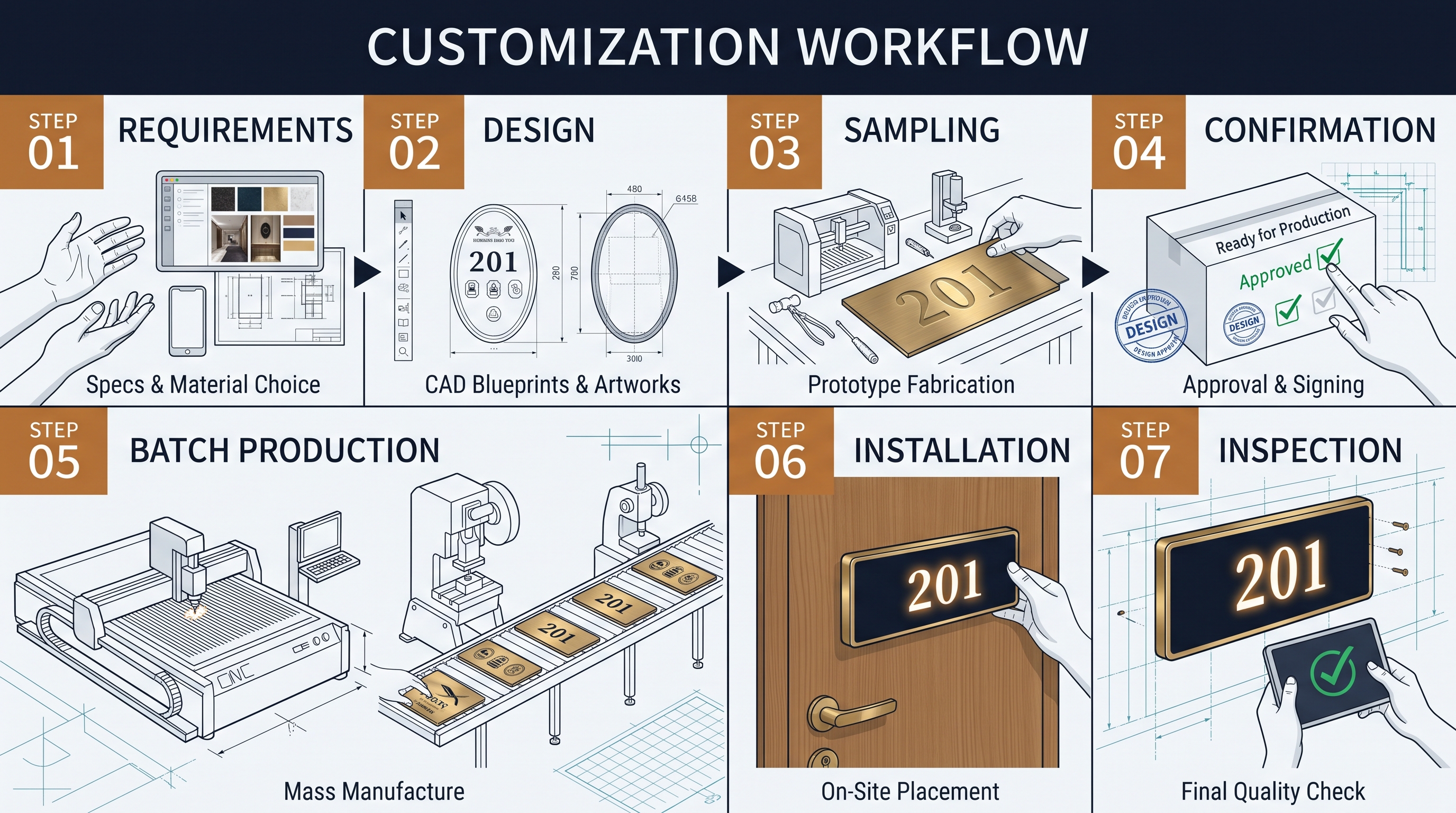
A hotel signage cost per room guide is most useful when it gives a team a repeatable way to build the budget, and the steps follow the same logic every time. The first step is to define the scope and count the sign types, listing every room number sign, every in-room hanger, every suite, meeting, directional, directory, and back-of-house sign, and confirming the material tier and the level of illumination and electronics. The second step is to obtain line-item quotations from one or two qualified OEM manufacturers, asking each to quote the same scope on the same all-in basis, with per-sign pricing, tooling and setup listed separately, MOQ, and lead time. The third step is to compute the per-room figure by dividing the total program cost by the room count, and to sanity-check it against the material-tier range so an outlier quote is caught early. The fourth step is to add the separately carried items, installation labor, any local permitting, and a contingency for artwork revisions and spare stock, to reach the all-in program budget.
Each step has a discipline that protects the number. The scope list must be complete, because a budget built on room number signs alone misses the wayfinding and back-of-house share and comes in low. The quotation comparison must normalize to the same basis, because a quote that drops packaging and freight looks cheaper than it is. The per-room figure is a check, not a target, so an implausibly low or high number sends the team back to the scope rather than being accepted. And the contingency must be real, because artwork revisions, braille corrections, and spare signs are normal costs in a signage program, not failures. A hotel signage cost per room guide that walks a team through these steps turns a fuzzy signage budget into a number the finance department can approve and the procurement team can hold the supplier to. Keeping the scope list, the normalized quotes, and the final budget on file also creates the baseline for future work, because a renovation or a rebrand later can be budgeted against the same framework instead of starting from zero.
Managing Lead Time and Quantity in a Hotel Signage Cost per Room Program
The hotel signage cost per room figure depends on the quantity and the lead time the program commits to, and a hotel signage cost per room guide should connect the budget to the schedule. The per-room cost falls as quantity rises, so the team that commits to the full program at once, rather than buying room signs in small increments, captures the volume discount and avoids paying a higher per-unit rate on reorders. The lead time interacts with quantity because production is queued in batches, so a single, well-defined order produces the whole run efficiently, while split orders restart setup each time and add cost and delay. For a new build, signage must arrive and install before opening, so the budget and the schedule are set together: committing early to a complete, finalized specification both locks a better per-room price and protects the opening date.
The schedule also shapes how the per-room figure is spent. In-room hangers and other consumables may be ordered in a larger quantity up front to take advantage of the volume price, even if some are used over time, while the architectural room number signs are ordered once for the life of the building. A hotel signage cost per room guide should help the team separate these cycles, because a budget that treats a five-year hanger supply as a one-time architectural cost overstates the opening budget, and one that ignores reorders understates the running cost. By planning the quantity and the lead time together, and by sourcing the complete program from one manufacturer, the team gets the lowest per-room cost, the shortest defensible timeline, and a reorder path that keeps the program consistent for years, which is the full return on a well-run signage budget.
Why a Hotel Signage Cost per Room Guide Pays for Itself
The return on investing in a proper hotel signage cost per room exercise is that it prevents the two costs that quietly wreck signage budgets: under-budgeting and overpaying. Under-budgeting shows up when the wayfinding, compliance, and back-of-house share is left out, and the team discovers mid-project that signage needs more money and more time than the plan allowed, forcing rushed, more expensive decisions. Overpaying shows up when the complete program is sourced from retail one sign at a time, paying a distribution markup on hundreds of pieces that a single OEM program could have produced at factory cost. A hotel signage cost per room guide that defines scope, sets the material tier, normalizes quotes, and steers the program to an OEM manufacturer addresses both errors at once, turning signage from a cost surprise into a controlled, predictable line item.
Because signage is a visible, long-lived part of the asset, the value of getting it right extends beyond the budget into the guest experience and the brand. A coherent, code-compliant signage program at a disciplined per-room cost protects the property's look, passes inspection, and serves guests and staff for the life of the building, while a scramble to cut cost at the end of construction tends to produce mismatched, non-compliant, or premature signs that cost more to fix later. A hotel signage cost per room guide gives procurement and finance the structure to buy signage as a planned program rather than a crisis, and to capture the manufacturing advantage without sacrificing quality. For any team about to budget a new build or a renovation, that is the guide's real payoff: a signage number that is honest, competitive, and defensible, before the first quote is even issued.
Not sure which sensor fits your project?
Talk to our mmWave application engineers for a free consultation.
Specify your hotel project with our engineers
Send your room count, ceiling type, and protocol preference. We will return a sample plan and quote within 24 business hours.
- Move from general guidance into a product or application discussion.
- Use RFQ when pricing, drawings, MOQ, or launch timing needs structure.
- Keep a direct contact path visible for fast clarifications and handoff.