Hotel Door Signs Selection Guide for Procurement
Hotel door signs selection guide: brass, acrylic, LED by cost, durability, mounting. MOQ, pricing tiers, and ADA compliance for hotel procurement teams.
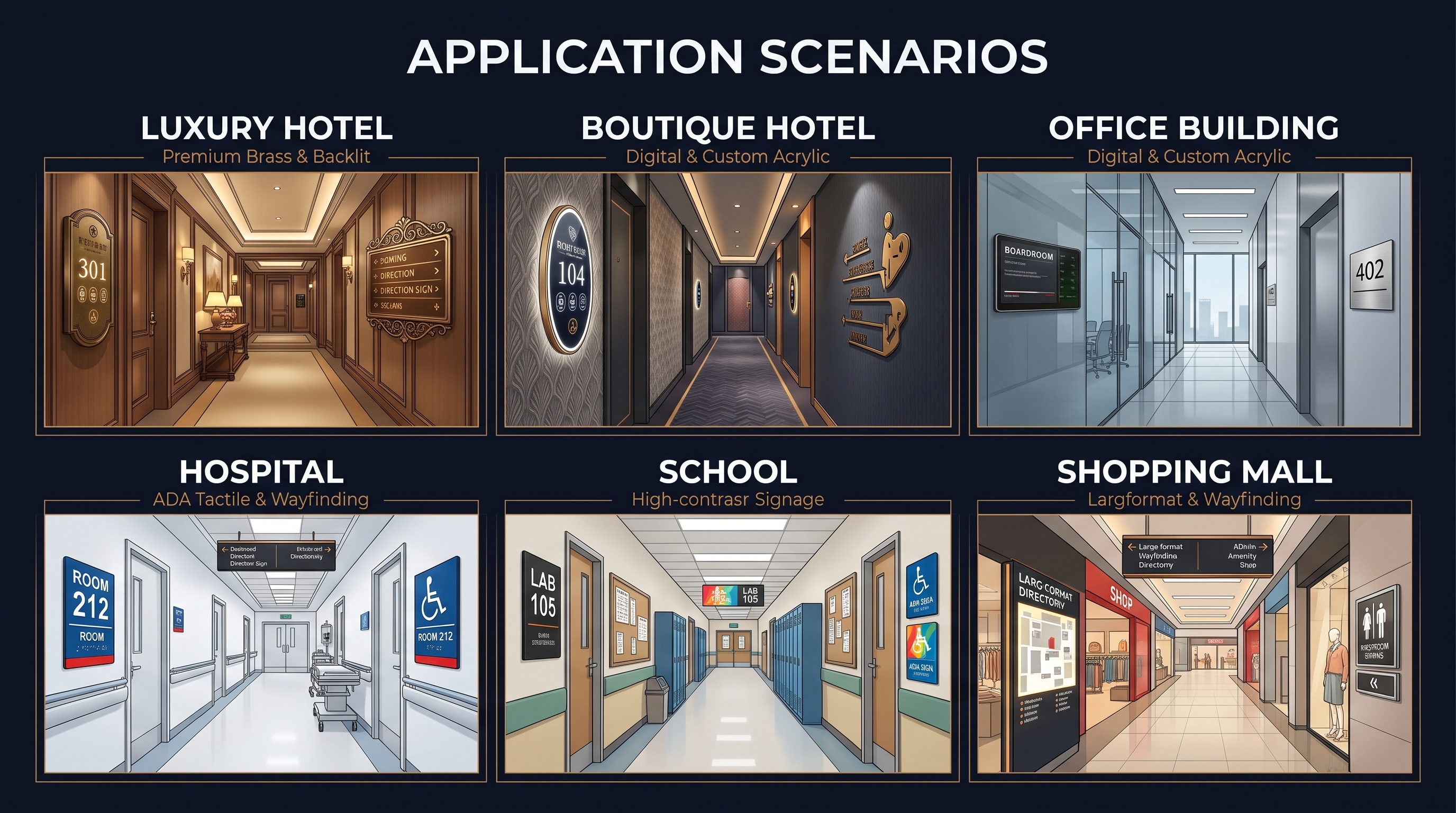
A hotel door signs selection guide is the foundational reference procurement teams need when specifying door identification systems for hospitality properties ranging from small boutique builds to multi-tower urban hotels with over one thousand rooms. The decision is rarely a single product choice but a layered specification covering material cost, mounting method, ADA compliance, fire code, lighting requirements, and brand-tier alignment across new construction and renovation contexts. Hotel door signs sit at the intersection of architectural finish and wayfinding infrastructure, and a poor choice creates lasting friction in guest experience and staff operations for the typical ten to fifteen year service life of a hospitality door sign. This hotel door signs selection guide walks through the critical decision points a procurement team must resolve before issuing a vendor RFQ, framed around the four key Pillar decisions any hotel door sign specification must answer: which material best matches brand tier, which mounting method is appropriate for the door construction, whether illumination is justified for the property type, and how MOQ and budget tiering affect the final cost per room.
Hotel door signs are permanent architectural elements that shape guest experience through clarity of navigation, perceived property quality, and daily staff interaction. Mounted on or adjacent to guest room doors, suite entrances, meeting rooms, service areas, and elevator lobbies, hotel door signs are the first point of spatial orientation for arriving guests and a critical wayfinding surface for housekeeping, maintenance, and security personnel. The hotel door signs category spans simple engraved door number plates to ADA-compliant tactile signs, illuminated room identifiers, branded suite plates, PMS-integrated status indicators, and architectural room number signs that double as design elements. For procurement teams, a hotel door signs selection guide helps navigate the trade-off between material grade, mounting durability, code compliance, and total project budget across new construction, renovation, and incremental replacement cycles.
Why Hotel Door Signs Selection Is More Strategic Than You Think
Hotel door signs selection is more strategic than most procurement teams initially perceive because each room identification represents a long-term installation with lasting guest interaction and staff workflow implications. Unlike temporary promotional signage or seasonal decoration, hotel door signs remain fixed in place for ten to fifteen years in typical hospitality operation, consistently influencing first impressions, navigation clarity, and perceived property quality. Hotel door signs require ADA-compliant font size, tactile numeral presentation, and braille labeling across guest rooms and meeting spaces regardless of brand standard, with modifications for temporary and accessible guest rooms adding further complexity to the specification. Frequent occupant turnover and unfamiliar environments increase reliance on hotel door signs for wayfinding and identification compared to office buildings or residential apartments, making sign clarity directly correlated with guest satisfaction scores and operational efficiency. Accurate identification enables quick room access, reduces guest confusion and wait times, and prevents the embarrassment and delays caused by misidentified suites and entrances. Staff also depend on hotel door signs for housekeeping assignments, maintenance scheduling, and security procedures, with confusion or misreads leading to extended room turnover times and guest room security risks.
Hotel door signs are an architectural product category where material choice, mounting method, and finish options collectively determine long-term cost of ownership more than upfront price alone. Common materials include brass with polished, brushed, or satin protective finish, aluminum with anodized, powder-coated, or painted color, acrylic with transparent, translucent, or colored transparent backgrounds, stainless steel with mirror, brushed, or hairline finish, wood with stained, veneered, or natural grain, and composite with laminate or digital printing applied. Brass hotel door signs offer premium heaviness and timelessness with passivation layers to resist tarnish and are easily engraved with sharp, clear numerals for guest room, suite, and meeting space identification. Aluminum hotel door signs provide mid-tier durability and color through anodizing or powder coating, introducing customization through color-matched frames, contrast numerals, and branding integration for luxury and upscale guest room builds. Acrylic hotel door signs deliver modern style, easy customization via digital printing, braille overlays, and braille integration for ADA compliance, and lower weight for easy installation. Stainless steel hotel door signs offer commercial maintenance environments, hospitals, and properties with routine cleaning protocols requiring corrosion-resistant materials able to withstand routine sanitization and repeated handling. Wood hotel door signs provide warmth and hospitality atmosphere with each room number indication enhanced by carved numerals, routed signage, or veneered materials at higher price considerations but with longer tenancy and architectural integration.
The strategic dimension of hotel door signs selection also extends to brand coherence and architectural identity. A hotel chain that mixes door sign materials across properties fragments its visual identity, while a property that selects the wrong finish for its corridor lighting or wall material creates a permanent mismatch that photographs poorly in guest reviews. Hotel door signs are also a frequent touch point in property photography and guest content creation, so a misaligned selection becomes a marketing liability rather than an operational one. The hotel door signs selection guide must therefore align procurement decision with brand, architectural, and operations stakeholders before any vendor engagement begins.
Brass Hotel Door Signs — Premium Aesthetics, Longest Durability
Brass hotel door signs deliver premium aesthetics, longest durability, and guest room identification demonstrating the highest level of craftsmanship, architectural integration, and property standard commitment. High-end and luxury hotels require brass through its natural properties of high wear resistance, elegant timelessness, and formal character when properly maintained in guest corridors, meeting rooms, and suite entrances. Brass hotel door signs are manufactured with passivation layers preventing tarnish and oxidation, ensuring legibility and high-end appearance for the full life of the property with routine cleaning and preventive upkeep. Engraved numerals achieve sharp, clear depth and definition along each room marking and suite designation, presenting tactile and visual contrast with precise dimensioning for navigation and identification clarity crucial to ADA compliance and guest satisfaction. Brass hotel door signs are typically 2.0 to 3.5 millimeters in thickness for premium feel and long-term durability in busy hospitality corridors with frequent touching, handling, and incidental contact from luggage, carts, and maintenance equipment. High-end brass finishes include polished brass with high-gloss, reflective surface, satin brass with matte appearance, brushed brass with directional grain, lacquer-protected brass for minimal patina, cloth-buffed brass for even luster, museum-grade brass coating for long-term indoor preservation, sealed brass for moderate humidity and moderate contact, and premium grade wax protection for routine cleaning and daily handling during guest operations. Each finish affects maintenance frequency, final cost, and daily handling, with higher gloss and unlacquered finishes requiring more frequent upkeep but offering character development over time for luxury property aesthetic experience.
Brass hotel door signs are purchased for their combination of precise legibility, durability through high-touch use, and architectural integration, with brass offering an unparalleled balance of premium material qualities and design suitability. Brass hotel door signs are applied in entrance signage, suite labeling, meeting room markers, ADA-compliant braille and tactile numerals, VIP suites, pool deck signage, elevator lobby markers, and hotel corridor identification throughout property builds ranging from luxury boutique hotels to high-end chain properties. Specifications for brass hotel door signs include font and numeral size requirements to ADA compliance, mounting and fastener options for varied door materials, braille content and placement to ADA and UFAS, room number sequence clarity for guest navigation, and finish protection to long-term appearance. Brass hotel door signs are installed using stainless steel screws, passivated fasteners to resist corrosion, back adhesive for lightweight installations such as framed doors, recessed mounting for flush installation on metal doors, and tamper-resistant fasteners for public and semi-public corridor placement requiring guest and staff security. Maintenance for brass hotel door signs is routine cleaning with mild soap and water, periodic polishing to restore luster and remove tarnish, recommended passivation renewal to preserve appearance, and cloth-polishing to maintain premium character without abrasive materials. Cleaning frequency for brass hotel door signs is day-to-day to high-touch areas such as suites, entrance halls, and frequent traffic rooms, biweekly to monthly to room corridors, quarterly to annual to suit maintenance, and semi-annual to annual to protective layer renewal. Brass hotel door signs are specified to long-term durability requirements including scratch and dent resistance for luggage handling, tarnish protection through environmental exposure, maintenance labor for asset preservation, corrosion-resistant fasteners for metal door installation, and designable numeral depth and proportion to clear guest reading at varied approach and exit angles.
Brass hotel door signs are also favored for their weight and perceived quality. A heavier brass sign communicates investment and permanence to arriving guests, reinforcing brand tier at the moment of room approach. The trade-off is installation labor: heavier brass signs require more substantial fasteners and longer installation time, which translates to higher per-room labor cost during initial deployment and during any subsequent replacement. For multi-tower renovation projects with hundreds of rooms, this labor differential is significant and must be priced into the hotel door signs selection guide decision matrix.
Acrylic Hotel Door Signs — Modern Style, Easy Customization
Acrylic hotel door signs deliver modern style, easy customization, and are manufactured for a clean, contemporary guest environment with digital printing, braille overlays, and translucent or transparent backgrounds achieving a sleek and lightweight aesthetic for hospitality properties. Fast-turnover midscale and upscale hotel projects often select acrylic hotel door signs due to cost, easy modification, and design variety matched to brand standards at competitive project pricing and easy logistics for tight construction schedules for room labeling, meeting markers, and braille and ADA requirements where architectural profile needs to blend architectural integration, easy installation, and guest-focused environment. Acrylic hotel door signs are available in transparent, translucent, and colored backgrounds with digitally printed numerals, brand integration through vinyl or printed inserts, texture matched to finish options for ADA and braille, and back-printed or front-engraved numerals with consistent contrast and readability for guest room identification, suite markers, and ADA and fire code compliance. Acrylic hotel door signs thickness ranges from 3.0 to 8.0 millimeters for easy installation and handling and lightweight placement on varied door materials, including hollow core, metal frames, and renovation applications requiring minimal fastener and adhesive force for construction site and final customer experience. High-quality acrylic hotel door signs with UV-stable inks resist color fade, routine surface cleaning, and routine handling, ensuring room number permanence and architectural appearance in guest corridors where daily traffic and varied approach keep identification consistent for repeated guest and staff interaction.
Acrylic hotel door signs are designed to deliver clarity of navigation, ADA-compliant accessibility, and uninterrupted guest wayfinding for properties of any size with acrylic signage balancing modern style, easy customization, and cost-efficiency for room numbers, suite identification, and routine labeling. Acrylic hotel door signs are applied in guest room corridors, meeting room entrances, elevator lobbies, ADA-compliant braille and tactile overlays, brand and resort integration into room markers, pool deck identification signage, and suite designation markers throughout projects ranging from small boutique to larger multi-tower properties. Specifications for acrylic hotel door signs include font and numeral size requirements to ADA compliance, mounting and fastener options for varied door materials, braille content and placement to ADA and UFAS, room number sequence clarity for guest navigation, and design and finish options for architectural coherence across varied door and corridor materials. Acrylic hotel door signs are installed using back adhesive for easy yet secure placement, removable fasteners for metal door installation, recessed cut-outs for flush surface presentation, tamper-resistant mounting for public spaces, and layered overlays for enhanced design and ADA compliance where ADA requires braille and tactile text. Maintenance for acrylic hotel door signs is routine dusting and cleaning to remove surface dirt, fingerprint removal to maintain clarity and appearance, and careful coating renewal to UV-stable materials to long-term appearance without abrasive materials for routine interaction. Cleaning frequency for acrylic hotel door signs is daily to high-touch areas such as suites and entrance halls, biweekly to monthly to guest room corridors for general appearance, quarterly to annual during scheduled maintenance to rebuild UV-stable coatings or overlays, and semi-annual to annual to protective layer renewal suited to moderate and heavy traffic. Acrylic hotel door signs are specified to durability, fade, and scratch resistance for luggage handling and cleaning products, easy installation and handling without hard fasteners, braille and ADA overlay permanence through varying guest interaction, maintenance labor to asset preservation, and dimensional consistency on varied door frames and corridors.
A key advantage of acrylic hotel door signs is the ability to produce small batches at low incremental cost. Unlike brass, where tooling and setup costs demand higher MOQ to amortize, acrylic hotel door signs can be digitally printed from a single design file and cut to size with minimal setup. This makes acrylic the preferred material for boutique hotels, soft brand collections, and properties that need to differentiate room numbers across multiple towers or wings with subtle visual variation. The cost per piece is lower than brass, but the perceived premium is also lower, so the selection depends on whether the property is positioning itself on luxury feel or on modern, fresh, accessible design language.
LED Illuminated Hotel Door Signs — Visibility Beyond Compare
LED illuminated hotel door signs deliver visibility beyond compare and are specified to properties requiring high visibility, all-hours guest identification, and low-light corridors with LED integration or back-lighting achieving eye-level illumination consistent with brand standards for suite entrances, meeting rooms, and identification markers where nighttime traffic and guest comfort are primary selection criteria. Hotels providing 24/7 casino operations, hospital guest floors, conference center facilities, and urban properties with night-life dining and suite traffic typically select LED hotel door signs due to permanent illumination, clear visibility, brand integration, and enhanced guest orientation through fully-lit numerals in context where dark corridors or nighttime traffic are dominant project requirements. LED illuminated hotel door signs are manufactured with internal power supplies, battery or hard-wired wiring, and diffuser layers providing even light across numerals, room numbers, suite identification, and braille and ADA-compliant overlays, ensuring clear identification for guests regardless of approach speed, traffic schedule, or corridor lighting conditions affecting navigation and guest experience during late hours. LED hotel door signs offer energy efficiency, long bulb life expectancy, and easy maintenance with routine bulb and driver replacement common for ten to fifteen year operation rather than full replacement for urban corridors, 24/7 internal traffic, and suite labeling throughout varied light environments and guest schedules requiring clear room identification and expectations for always-on visual cues for room orientation and arrival experience.
LED hotel door signs are engineered to serve as clear, reliable identification in high-approach corridors, low-light environments, and night-heavy guest activity settings with LED illumination signaling arrival, wayfinding, and architectural integration throughout a guest stay at hospitality properties. LED hotel door signs are applied in suite entrance illumination, meeting room markers, pool deck signage, casino corridors, 24/7 internal sleeping room, guest traffic floor markers, night-layer lobbies, and pool deck signage throughout properties with extended internal traffic, night events, and 24/7 guest activity requiring consistent labeling uncompromised by corridor lighting conditions for all guest traffic regardless of arrival schedule. Specifications for LED hotel door signs include font and numeral size requirements to ADA and fire code guidelines, mounting and power options for varied installations, braille content and placement to ADA and UFAS, room number sequence clarity for guest navigation, and consistent lighting to all-night identification for guest comfort and ease of room identification where corridor lighting may be low or inconsistently maintained. LED hotel door signs are installed using hard-wired power through dedicated low-voltage circuits for 24/7 operation, battery power with front or back battery access for easy change, wireless or IR signal for room status display such as occupied or Do Not Disturb indicators, panel-mounted or recessed installation where flush line is desired for architectural integration, and tamper-resistant mounting for public and semi-public corridor placement requiring guest and staff security in high-efficiency hospitality settings. Maintenance for LED hotel door signs is routine visual inspection for clean and illuminated numerals, battery exchanges every 12 to 24 months during scheduled maintenance, periodic driver renewal to extended lifespan, and careful surface protection to surface cleanliness to maintain clarity and appearance where daily guest interaction may cause routine wear and need for consistent appearance. Cleaning frequency for LED hotel door signs is daily to high-touch areas such as suites and entrance halls with night-time traffic, biweekly to monthly to guest room corridors for scheduled maintenance to batteries and drivers, quarterly to annual for device renewal during scheduled maintenance, and semi-annual to annual to protective layer renewal for surface materials. LED hotel door signs are specified to electrical code compliance for low-voltage corridor installation, long-term energy efficiency for extended operation, warranty and lifespan matching to material, and routine handling and durability to luggage, maintenance, and guest traffic where room identification is both routine arrival and repeated traffic throughout guest night and event schedules.
The operational cost of LED hotel door signs extends beyond the unit price. Properties must plan for low-voltage electrical infrastructure during construction, maintenance labor for driver and bulb replacement, and battery replacement for wireless installations. For renovation projects, the cost of running new low-voltage wiring through existing corridors can exceed the cost of the hotel door signs themselves, which is why LED retrofit is often cost-effective only for corridors with existing conduit or for properties replacing failed non-illuminated signs at scale.
Hotel Door Signs Installation — Mounting Options and Labor Cost
Hotel door signs installation and mounting options are specified for building type, door material, project budget, and maintenance labor expectations to ensure secure placement, ADA compliance, and guest visibility for room identification systems for project size ranging from small 30-room properties to 2,000-room multi-tower builds with installation time, fastener selection, and mounting method collectively determining project labor and sign longevity in rental guest corridors, conference meeting rooms, and suite entrance spaces. Door materials include metal frame, hollow core core, solid core core, veneered surfaces, laminated surfaces, and retrofit frame-in-front, each requiring fastener selection matched to material to secure placement, ensure clean, consistent appearance, and maintain ADA-compliant room labeling and braille through repeated guest interaction and routine maintenance scheduling for ten to fifteen years of operation. Fasteners for hotel door signs installation are chosen according to weight, door material, frequency of interaction, and maintenance labor match for guest room corridors, suite labeling, and public and semi-public identification where each hotel door sign is subject to luggage, guest interaction, housekeeping cart, and maintenance equipment throughout daily traffic and extended operation.
Hotel door signs are installed to be secure for routine guest interaction, clear and consistent through repeat guest and staff traffic, and code-compliant for ADA, fire egress, and architectural integration ensuring guest arrival, wayfinding, and identification standards met for hospitality properties. Typical fasteners are standard screws for most door material to metal frames, hollow core, and routine renovation for new-construction projects requiring minimal cost for permanent attachment, stainless steel screws for corrosion-resistant fasteners for humid and high-touch areas like suites, entrances, lobby, and corridors for daily guest interaction and luggage handling, tamper-resistant fasteners for public and semi-public spaces where guest security is required by safety and public-space ordinances for guest room corridors, adhesive backings for lighter-weight placement on veneered doors, laminate, and frame-in-front installations for easy installation and minimal fastener requirement for renovation, magnetized overlays for flexible installation and easy aesthetics for high-traffic rooms, and recessed mounting for flush accommodation and surface appearance to metal doors and new build where maximum surface is desired and architectural integration is key for elevated property standards. Installation fixtures are chosen in consideration of ADA-compliant tactile and braille placement, field-of-approach for guest traffic for front-facing numerals, room number sequence and signage hierarchy, and room number clarity for accessibility and guest navigation. Material compatibility, fastener grip on door material, and cost sensitivity are specified for universal application for new construction and renovation projects for installation time, fastener selection, and architectural integration across varied door materials where each hotel door sign is subject to luggage, guest interaction, and routine maintenance for daily guest operations. Labor cost for hotel door signs installation is determined by door type and material, fastener match for door type, surface finish permanence for surface appearance, routine labor expectations for task scheduling, and architectural cohesion for finish and mounting for varied approaches and room number arrangments on varied hotel corridors.
The labor cost of hotel door signs installation is often underestimated in early-stage procurement. A typical brass hotel door sign with two screw mounts requires approximately 4 to 6 minutes of installer time per sign for a trained facilities team, but for renovation projects on occupied floors where work must be scheduled around guest stays, the effective labor cost can be 3 to 5 times higher. For new construction with clear floor access, hotel door signs installation can be folded into the door hanging subcontractor scope and cost per sign drops significantly. This is why renovation projects often favor adhesive-mounted acrylic signs, which can be installed by housekeeping staff in occupied rooms without specialized tools or subcontractor coordination.
Hotel Door Signs MOQ and Budget Planning — Pricing Tiers Explained
Hotel door signs MOQ, minimum order quantities, and budget planning are determined for project size, manufacturing method, and delivery schedules to project cost for room identification systems for hotels ranging from small boutique projects of 15 rooms to property acquisitions and renovations with 500 or more rooms with MOQs for hotel door signs varying from 50 pieces to 1,000 pieces for different suppliers, materials, and manufacturing methods driving upfront cost, logistics handling, project schedule, and architectural integration across a hospitality build with routine guest operation, suite traffic, and varied scope of guest numbering systems. MOQs for hotel door signs are specified by supplier commitment, manufacturing method, material minimum, and delivery scheduling for projects requiring tailored schedule and product matching to room numbering, room identification, suite labeling, and brand standards with uniform appearance across a property with integrated hotel door signs, number marking, and routine staff and guest interaction for guest identification and wayfinding for ten to fifteen years of property operation. Project scope for hotel door signs MOQs includes room number blocks and numbering sequence requirements, suite designation for brand standard labeling, mechanical rooms and area identification, elevator lobby identifying markers, ADA and UFAS compliance requirements, custom room numbering for suite and renovation, brand standards for material and finish, architecture and corridor finish matching, and routine maintenance logistics for replacement and repair for room identification systems for guest traffic and architectural integration ensuring brand standard durability, legibility, and ADA compliance for long-term operation.
Hotel door signs are specified and budgeted to property standard for architectural integration, guest experience through clarity of identification, and routine maintenance scheduling for operations for MOQ, budget planning, and pricing tiers across project size and property type for room identification for guest arrival and wayfinding for daily guest operations. MOQ tiers are 50 to 100 pieces for small project and boutique hotel placement through low-volume, high-quality manufacturers for custom room numbering, routine renovation, and hotel build where volume drives lead time but quality is critical for guest experience in small-scale and boutique projects with room identification systems for guest orientation, 100 to 250 pieces for midscale projects and chain property expansions through mid-volume, mid-cost for routine procurement for room numbering, suite, and routine labeling for guest identification and wayfinding for routine guest behavior, 250 to 500 pieces for upscale project with mid-volume, high-quality for high-cost, high-touch properties with suite labeling and routine guest interaction where material quality and finish are critical for guest arrival and orientation, 500 to 1,000 pieces for luxury and premium project requiring high-quality, high-cost with low-maintenance, long-lasting material and architectural integration for guest room identification through upgraded, higher-visibility signage meeting guest expectation for premium experience and routine room numbering, and 1,000 pieces or over for high-volume projects and property acquisition, renovation, and expansion requiring long-term guest interaction and room identification support guest traffic and guest orientation with quantity and quality for high-touch guest arrival and wayfinding for extended operation. Budget planning for hotel door signs includes MOQ and upfront cost for minimum commitment, delivery schedule and lead time, shipping logistics for multi-tower, multi-building project, architectural integration for finish and surface matching, ADA and fire code compliance for tactile, braille, and routine regulatory installation, and routine maintenance labor and replacement logistics for room identification systems for guest interaction, wayfinding, and clear room identification for varying guest schedules and routine operation for guest comfort and clear identification for room numbering and room identification through routine traffic.
Total cost of ownership for hotel door signs extends well beyond unit price and installation labor. Procurement teams should budget for replacement stock (typically 5 to 10 percent of installed quantity) to handle damage, vandalism, and routine replacement over the asset life. For a 300-room property, this means 15 to 30 spare hotel door signs of each variant, which can add 5 to 8 percent to the initial project budget. Properties with high guest turnover or with conference center floors hosting external events often budget higher replacement stock to avoid operational disruption from missing or damaged signs.
Hotel Door Signs Material Comparison — Brass vs Acrylic vs LED vs Stainless Steel
Hotel door signs material comparison consolidates the brass, acrylic, LED, and stainless steel options into a single decision matrix that procurement teams can use to evaluate trade-offs side by side. Each hotel door signs material carries a distinct cost profile, durability profile, maintenance profile, and architectural profile, and the right selection depends on the property tier, the corridor environment, the brand standard, and the total project budget. The hotel door signs selection guide uses this comparison to expose the cases where a lower unit price creates a higher total cost of ownership, and the cases where a premium material is genuinely justified by operational savings.
The first comparison dimension is unit cost. Brass hotel door signs carry the highest unit cost, typically 3 to 5 times the cost of acrylic hotel door signs of comparable size, due to raw material price and the engraving labor required for each numeral. Acrylic hotel door signs carry the lowest unit cost, especially in volumes above 100 pieces where digital printing amortizes setup cost. LED hotel door signs carry a unit cost between brass and acrylic but add infrastructure cost for low-voltage wiring or battery replacement. Stainless steel hotel door signs carry a unit cost comparable to brass but with lower engraving cost because the material is harder and accepts laser etching rather than mechanical engraving.
The second comparison dimension is durability. Brass hotel door signs offer the longest service life, routinely exceeding fifteen years in indoor hospitality corridors with proper maintenance. Stainless steel hotel door signs offer comparable durability with superior corrosion resistance for humid or coastal properties. Acrylic hotel door signs offer a service life of seven to ten years before UV exposure and surface scratching begin to degrade legibility. LED hotel door signs offer a mechanical service life of ten to fifteen years but require driver or battery replacement at three to five year intervals to maintain illumination.
The third comparison dimension is maintenance labor. Brass hotel door signs require periodic polishing and passivation renewal, adding roughly 0.5 to 1 minute of housekeeping labor per sign per month in high-touch corridors. Acrylic hotel door signs require only routine dusting and fingerprint wiping, adding roughly 0.2 minutes per sign per month. Stainless steel hotel door signs require routine wiping with stainless cleaner, adding roughly 0.3 minutes per sign per month. LED hotel door signs require battery or driver replacement at scheduled intervals, adding roughly 2 to 4 minutes per sign per replacement cycle but at lower frequency.
The fourth comparison dimension is ADA compliance. All four hotel door signs materials can be specified to meet ADA tactile and braille requirements, but the implementation differs. Brass hotel door signs use mechanically engraved tactile numerals and applied braille beads. Acrylic hotel door signs use raised acrylic overlays or applied braille beads. Stainless steel hotel door signs use chemically etched tactile numerals and applied braille beads. LED hotel door signs must layer illumination over a tactile substrate, which adds complexity and cost to ADA-compliant variants.
| Material | Unit Cost | Service Life | Monthly Maintenance | ADA Implementation | Best Fit |
|---|---|---|---|---|---|
| Brass | Highest | 15+ years | 0.5–1 min/sign | Engraved tactile + braille beads | Luxury, upscale |
| Acrylic | Lowest | 7–10 years | 0.2 min/sign | Raised overlay + braille beads | Midscale, boutique |
| LED | Mid + infra | 10–15 years | 2–4 min/cycle | Layered over tactile substrate | 24/7, night traffic |
| Stainless Steel | High | 15+ years | 0.3 min/sign | Etched tactile + braille beads | Coastal, humid |
The fifth comparison dimension is architectural integration. Brass hotel door signs pair naturally with wood-paneled corridors and traditional luxury interiors. Acrylic hotel door signs pair naturally with modern, minimalist interiors and soft brand collections. LED hotel door signs pair naturally with urban properties and conference center floors where nighttime traffic is significant. Stainless steel hotel door signs pair naturally with contemporary interiors and with properties in coastal or humid climates where brass tarnish would be a maintenance burden. The hotel door signs selection guide uses this material comparison to narrow the shortlist before vendor engagement, so that RFQs go only to manufacturers who produce the selected material at the required quality and volume.
Hotel Door Signs Specification Checklist for Procurement Teams
A complete hotel door signs specification checklist consolidates the previous sections into a decision matrix procurement teams can use to brief vendors and validate proposals. The first checklist item is material selection, which captures the brand tier, the architectural finish, the budget per room, and the expected service life. The second is mounting method, which captures door material, fastener type, and installation labor estimate. The third is illumination, which captures corridor lighting, nighttime traffic profile, and electrical infrastructure availability. The fourth is ADA and UFAS compliance, which captures tactile numeral size, braille content, room number sequencing, and accessible room modifications. The fifth is MOQ and budget tier, which captures the supplier commitment, the project scale, and the total cost of ownership including replacement stock. The sixth is delivery schedule, which captures the construction or renovation timeline, sample lead time, and phased delivery requirements for multi-tower projects.
The seventh checklist item is brand standards, which captures the hotel chain brand book, the architectural material palette, the visual identity, and the conformance to any prior properties in the chain. The eighth is supplier qualification, which captures the manufacturer certifications such as ISO 9001, the export experience for hospitality projects, the references from comparable properties, and the customization capability for unique room numbering or branding requirements. The ninth is warranty and after-sales support, which captures the defect replacement commitment, the labor coverage, the spare parts availability, and the response time for in-warranty claims. The tenth is total cost of ownership, which captures unit price, installation labor, replacement stock, routine maintenance labor, and expected replacement cycle over the asset service life.
Procurement teams that walk through this hotel door signs specification checklist before issuing a vendor RFQ typically achieve a 15 to 25 percent reduction in total project cost compared to teams that select on unit price alone, because the structured decision matrix exposes material, mounting, and lifecycle trade-offs that affect long-term cost but not initial quote. The hotel door signs selection guide is therefore as much a financial planning tool as it is a product specification resource.
Part of this article content is generated by AI and optimized for professional accuracy and readability.
Not sure which sensor fits your project?
Talk to our mmWave application engineers for a free consultation.
Specify your hotel project with our engineers
Send your room count, ceiling type, and protocol preference. We will return a sample plan and quote within 24 business hours.
- Move from general guidance into a product or application discussion.
- Use RFQ when pricing, drawings, MOQ, or launch timing needs structure.
- Keep a direct contact path visible for fast clarifications and handoff.