Custom Hotel Signage OEM Sourcing Guide for Procurement
Custom hotel signage OEM sourcing guide: select a manufacturer, define artwork, manage MOQ, samples, lead time, compliance, and shipping for branded signs.
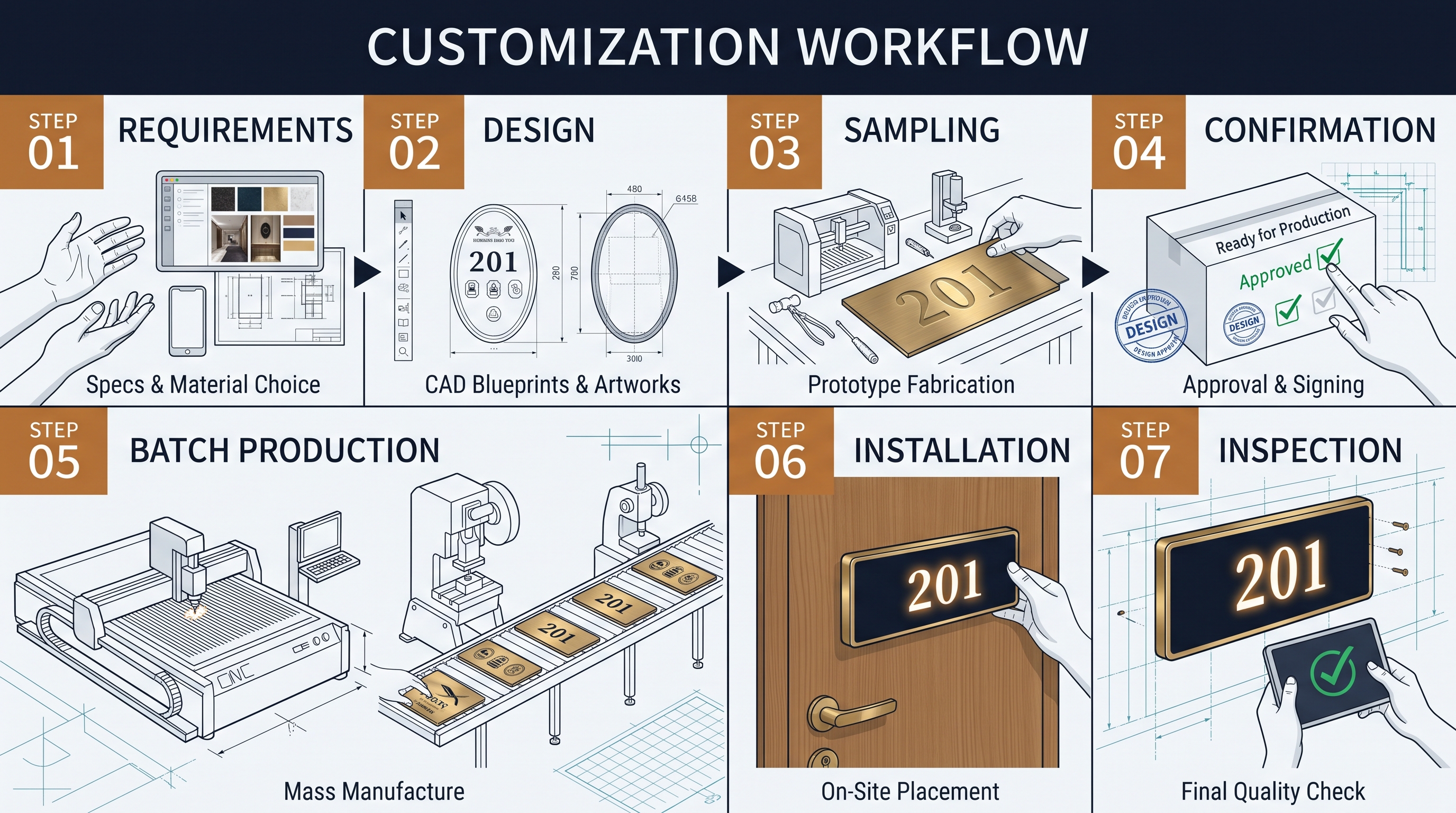
A custom hotel signage OEM sourcing guide is the playbook procurement teams use when they buy branded hotel door signs and in-room signage not from a retail catalog but from a manufacturer that builds the signs to their specification. In the hospitality supply chain, this distinction matters enormously. Retail sign shops in the destination market sell ready or lightly customized signs in small quantities at consumer prices. An OEM manufacturer, typically based in a manufacturing hub such as Shenzhen, China, produces custom hotel signage in bulk to a buyer's artwork, material, size, and compliance requirements, at unit prices that can be a fraction of retail once quantities justify the tooling and setup. For a hotel chain equipping a hundred-room property, a rebrand program across several hotels, or a distributor stocking branded sign lines, a custom hotel signage OEM sourcing guide turns a risky overseas purchase into a repeatable, documented process covering supplier selection, artwork, samples, MOQ, lead time, compliance, quality control, and shipping.
Custom hotel signage covers the full family of branded signs a property installs: room number signs, do not disturb and make-up-room signs, suite name plates, meeting and conference room signs, staff and back-of-house signs, directional markers, and the electronic status signs that integrate with property management systems. What makes them custom is not just the logo and colors but the material grade, thickness, finish, mounting method, and compliance details specified for the project. An OEM manufacturer adds value exactly where retail cannot: turning a brand spec into thousands of identical, code-compliant, durable signs at scale, with samples approved before production and a quality inspection before shipment. This guide walks through every step of that custom hotel signage OEM sourcing process so a procurement team can run the project with confidence and avoid the delays, quality surprises, and compliance failures that sink poorly managed overseas sign projects.
Why Custom Hotel Signage Needs an OEM Sourcing Strategy
Sourcing custom hotel signage from an OEM is fundamentally different from buying retail signs, and a custom hotel signage OEM sourcing guide exists because treating the two the same way leads to failure. Retail purchasing is immediate, low-risk, and per-unit; OEM sourcing is planned, higher-stakes, and batch-based. When a hotel group orders custom signage from an OEM manufacturer, it commits to artwork, materials, and quantities weeks or months in advance, pays deposits, and waits through production before the signs arrive. The benefit is that a well-run OEM project delivers an entire property's signage at a coherent standard and a cost that scales with volume, which is exactly what a brand needs when it is rolling out a look across many rooms or many properties. The discipline required is specification, documentation, sampling, and inspection, and that discipline is what this guide instills.
The economics are the reason OEM sourcing exists. Custom hotel signage in bulk from a manufacturing hub can cost a fraction of per-unit retail, because tooling, material, and labor costs are amortized across volume and because the buyer is paying factory cost plus margin rather than retail distribution markup. A single engraved brass room number sign bought retail might cost several times what the same sign costs in a bulk OEM order of two hundred pieces. The trade-off is the complexity of the transaction: currency, incoterms, lead time, distance, and language all add risk that a domestic retail purchase simply does not have. A custom hotel signage OEM sourcing guide does not pretend that risk away; it gives procurement the checklist to manage it, turning the lowest-cost supply route into a controlled, repeatable process rather than a gamble.
The Custom Hotel Signage OEM Sourcing Process Step by Step
Every custom hotel signage OEM project follows the same skeleton, and a custom hotel signage OEM sourcing guide should make that skeleton explicit so the team knows what comes next. The first step is specification, where the buyer defines the sign types, quantities, sizes, materials, finishes, colors, and compliance requirements for the whole project, ideally as a schedule that an OEM can quote against. The second step is artwork, where logos, fonts, room number sequences, braille, and any wayfinding layout are prepared in the vector formats the manufacturer needs for engraving or printing. The third step is the quotation and sample cycle, where the OEM returns unit pricing, tooling and setup costs, MOQ, and lead time, and produces a pre-production sample or mockup for approval before any batch is committed. The fourth step is production, where the manufacturer builds the approved run, runs its own quality checks, and prepares certificates. The fifth step is inspection and shipping, where the buyer, or a third-party inspector, verifies a sample of the finished signs against the specification before the freight is booked under the agreed incoterms.
Getting the first two steps right is what separates smooth projects from painful ones. A complete custom hotel signage specification should name the material, thickness, edge finish, mounting hardware, and the exact ADA or other compliance standard for every sign, because an OEM can only quote and build what is written down. Artwork must be delivered in vector format with fonts outlined and logos at the correct resolution, so the manufacturer can engrave or print without guesswork. When the specification and artwork are precise, the quotation is accurate, the sample matches the intent, and the production run reproduces the sample. When they are vague, every later step reopens decisions, costs drift, and the property ends up with signs that do not match the brand standard. A custom hotel signage OEM sourcing guide should therefore lead with specification and artwork, because they are cheap to fix at the start and expensive to fix after production begins.
What Drives Custom Hotel Signage Cost in an OEM Quote
Understanding cost drivers lets a procurement team negotiate a fair custom hotel signage OEM price and make trade-offs that matter, and a custom hotel signage OEM sourcing guide should demystify how factory quotes are built. The dominant cost drivers are material, process, and quantity. Material drives the base price: brass and stainless steel cost more per sign than acrylic, and premium finishes add cost on top of the material itself. The manufacturing process also shapes price, because engraving metal, printing acrylic, and laser-cutting are different operations with different setup and cycle times, and CNC engraving of a detailed logo costs more than a simple printed numeral. Quantity is the biggest lever, because tooling, artwork setup, and machine changeover are fixed costs spread across the run, so moving from fifty to five hundred signs typically drops the per-unit price meaningfully. Custom hotel signage cost should be quoted and compared on a per-sign basis with the tooling and setup listed separately, so the buyer can see exactly what volume unlocks.
Beyond the core drivers, several secondary costs appear in an honest OEM quote and should never be surprises. Tooling or mould fees appear on runs where a mould is needed, though many metal and acrylic signs are made without a mould, using CNC and printing instead, so tooling is not automatic. Branding and artwork setup, screen charges for printing, and packaging costs are typically itemized. Compliance and testing, such as certifying a fire rating or arranging a third-party inspection, carry their own fees. Shipping and duties are usually quoted separately under the incoterms, which a guide should spell out. A reliable OEM manufacturer presents a line-item quotation that separates material, process, tooling, packaging, and logistics so the buyer can see where money goes and negotiate on the levers that matter, rather than accepting a single opaque lump-sum figure that hides margin and leaves no room to optimize.
MOQ, Samples, and Lead Time in Custom Hotel Signage OEM Sourcing
Three operational parameters define every custom hotel signage OEM project: the minimum order quantity, the sample process, and the lead time. The MOQ is the smallest batch a manufacturer will run at the quoted unit price, and it exists because production setup, artwork, and machine time have fixed costs that make very small runs uneconomic. For standard hotel sign types, MOQs are often modest, in the range of fifty to two hundred pieces, and negotiable for an OEM/ODM partner, while complex or custom-printed signs may carry higher MOQs. A custom hotel signage OEM sourcing guide should treat MOQ not as an obstacle but as a planning number: the buyer decides whether to order enough to hit a good price per sign or to accept a higher per-unit cost for a smaller commitment, and a strong supplier will advise on the quantity that balances cost with the property's real needs.
The sample process is the quality gate that protects the whole project. A responsible OEM produces a pre-production sample, or at minimum a detailed mockup, before the full run, so the buyer can confirm material, finish, color, braille, and overall look against the brand standard. The sample is approved in writing, and that approval is what the production run must reproduce. Skipping the sample to save time is a common and expensive mistake, because a subtle finish or color mismatch that looks acceptable on screen becomes obvious across hundreds of installed signs. Lead time covers the full cycle from confirmed order to shipment: typically seven to ten days for samples and twenty to thirty days for mass production of a hotel sign order, plus ocean or air freight time. A custom hotel signage OEM sourcing guide should lock these three numbers early, because they drive the construction and renovation schedule, and a supplier that quotes both a sample lead time and a production lead time in writing is one a buyer can schedule around.
Compliance and Quality Control in Custom Hotel Signage OEM Sourcing
Compliance is where a custom hotel signage OEM project either succeeds cleanly or fails expensively, and a custom hotel signage OEM sourcing guide must put compliance at the center. The signs installed in a U.S. property must meet the ADA standard for tactile room and space identification, with raised characters, Grade 2 braille, correct dimensions, and mounting height. Signs exported into the European market need CE compliance and RoHS for restricted materials, and electronic signs need FCC certification in the United States. Fire-rated corridor signage must meet the relevant building and fire code. An experienced OEM manufacturer builds compliance into the design, confirms it in the shop drawing, and provides documentation, but the buyer should specify the standard explicitly and ask for the certificate and test evidence rather than assuming it. Because room number and status signs repeat across the property, one compliance failure is multiplied across every door, which makes confirmation of compliance before mass production essential.
Quality control is the manufacturing counterpart to compliance, and it determines whether the finished signs match the approved sample at scale. A professional OEM runs in-process checks and a final quality inspection, verifying dimensions, material thickness, finish consistency, engraving or print quality, braille, mounting hardware, and packaging against the specification. Many overseas buyers add a third-party inspection service that samples a portion of the run at the factory before shipment, and a reputable OEM welcomes this because it protects both sides. The inspection report, the compliance certificates, and the packing list together form the documentation that lets the signs clear customs and satisfy the installer and the authority having jurisdiction. A custom hotel signage OEM sourcing guide should therefore specify both compliance and quality control in the purchase, choosing a supplier that offers documented inspection and certification rather than one that ships on trust.
Selecting a Reliable Custom Hotel Signage OEM Supplier
Supplier selection is the decision that most determines the outcome of a custom hotel signage OEM project, and a custom hotel signage OEM sourcing guide should give procurement a clear way to qualify candidates. The first screen is proof of manufacturing: does the supplier actually run sign production, with its own engraving, printing, or laser equipment, or is it a trading intermediary that sources from unknown factories? A genuine manufacturer shows production capability, a factory address, and the processes it runs in house. The second screen is experience: does the supplier produce hotel signage specifically, with hotel projects, brands, and code-compliant work it can reference, and does it understand ADA, CE, and hotel door sign details? The third screen is documentation: the supplier should provide a clear quotation with line items, written lead times, compliance certificates, and a defined sample process. A supplier that is vague on any of these is a risk, however attractive the headline price.
Beyond the basic screens, a reliable partner demonstrates communication and process discipline that make the project run smoothly. They respond to artwork revisions, answer specification questions precisely, confirm details in writing, and manage the sample and inspection milestones without needing constant chasing. They are transparent about MOQ, tooling, and shipping under the agreed incoterms, and they are willing to produce a sample before committing the run. For larger programs, a factory visit or video audit confirms the operation and the quality process first hand, and third-party inspection adds independent verification. The strongest signal of reliability is the sample: a supplier that produces an accurate sample against the spec, on time, and with the right documentation is far more likely to deliver the run to standard than one that talks a good pitch and then under-delivers. A custom hotel signage OEM sourcing guide should treat the sample and the quality of the quotation as the practical proof of whether a supplier is worth the rest of the project.
It is also worth qualifying the supplier for scale, because a custom hotel signage project can grow beyond a first order. A hotel group that orders signage for a single pilot property today may want the same standard for several more properties, a distributor may want to restock a branded sign line, and a renovation program may need replacement signs for years. A manufacturer with monthly capacity measured in the tens of thousands of pieces, spare or repeatable tooling, and a documented process for reorders can support that growth without the buyer switching vendors and losing consistency. The supplier should also state its capacity, its standard production and sample lead times in writing, and whether it can hold the artwork and specifications on file so a reorder of matching signs later is simple. A custom hotel signage OEM sourcing guide should screen for this long-term fit, not just for the cheapest first order, because the real value of an OEM relationship is the consistency it delivers across every order, not only the first shipment.
Designing Custom Hotel Signage That Survives OEM Production
Design decisions made at the buyer's desk have a direct effect on how well custom hotel signage survives OEM production, and a custom hotel signage OEM sourcing guide should flag the specifications that translate cleanly to the factory. Logos and numerals should be delivered as clean vector artwork with fonts outlined, because fonts that are not outlined or images delivered as low-resolution rasters will engrave or print poorly. Colors should be matched with the exact Pantone or CMYK values the manufacturer needs, and the buyer should approve a physical sample because screen color is not reliable for a painted or printed sign. Room number sequences and braille content should be finalized and double-checked, since correcting a numeric sequence or a braille cell after engraving means remaking the sign. Material and thickness should be chosen for the manufacturing process and the installation surface, not just the look, so the sign installs cleanly and holds up in the corridor environment.
Design for manufacturability also means simplifying where it adds cost without value. A very thin font or a highly detailed engraving may look elegant on screen but cost more and become more fragile in production and on a high-traffic door. Complex multi-layer construction and exotic finishes add cost and lead time, so a guide should help the buyer separate the brand-critical details worth paying for from the decorative flourishes that can be simplified. Mounting is a design decision too: the sign's fastener method, whether screws, adhesive, or a recessed mount, should suit the door construction and be specified clearly so the factory delivers matching hardware. When the artwork, color, dimensions, braille, material, and mounting are all defined cleanly, a custom hotel signage OEM project moves through production fast, reproduces the sample accurately, and installs without rework. Design quality is therefore a procurement responsibility, not just a creative one.
Shipping and Incoterms for Custom Hotel Signage OEM Projects
The final phase of a custom hotel signage OEM project is moving the finished signs to the property, and a custom hotel signage OEM sourcing guide should make the shipping decision explicit because it shapes both cost and risk. The incoterms chosen decide where responsibility passes from seller to buyer. FOB Shenzhen, for example, transfers risk and cost to the buyer once the signs are on board the vessel, with the buyer arranging ocean freight and import. CIF and DDP shift more cost and risk to the seller, with DDP delivering the signs cleared and delivered to the destination, which many overseas buyers prefer for simplicity even at higher price. EXW leaves all transport to the buyer from the factory door. For a hotel sign order of moderate weight and value, consolidated ocean freight is the economical default, with air freight an option when the schedule demands faster delivery despite higher cost. A reliable OEM quotes each incoterm clearly so the buyer sees the total landed cost, not just the factory price.
The packaging and documentation in shipping are where a well-run custom hotel signage OEM project shows its quality. Engraved and polished signs are packed with protective film, tissue layering, and corrugated board so they arrive without scratches or chipped edges, and electronic signs are packed with anti-static and cushioning protection. The commercial invoice, packing list, certificates of compliance, and, for some markets, the original bills of lading accompany the shipment and are required to clear customs. A guide should confirm that the supplier provides correct export documentation, labels the cartons, and packs to survive the actual freight mode chosen. Customs delays and damaged freight are common failure points in overseas sign sourcing, and both are largely prevented by specifying clear incoterms, protective packaging, and complete documentation up front. With those settled, the custom hotel signage OEM project closes the loop: specification, artwork, samples, production, inspection, and delivery, each managed deliberately, so the property receives a complete, compliant, brand-aligned signage system at the cost advantage the sourcing decision was made to capture.
Not sure which sensor fits your project?
Talk to our mmWave application engineers for a free consultation.
Specify your hotel project with our engineers
Send your room count, ceiling type, and protocol preference. We will return a sample plan and quote within 24 business hours.
- Move from general guidance into a product or application discussion.
- Use RFQ when pricing, drawings, MOQ, or launch timing needs structure.
- Keep a direct contact path visible for fast clarifications and handoff.